

Dental Implants vs. Dentures: Which Option Is Right for You?
Missing teeth can affect more than the appearance of your smile. They can make it harder to chew, speak clearly, and feel confident in everyday life. Over time, missing teeth may also affect your bite, facial structure, and overall oral health.
If you are looking into tooth replacement options, two of the most common solutions are dental implants and dentures. Both can help restore your smile, but they work in different ways and offer different benefits.
At Spokane Family Dental, we help patients throughout Spokane Valley and the greater Spokane area compare their options clearly. Whether you are missing one tooth, several teeth, or a full arch of teeth, the right solution depends on your goals, oral health, budget, and long-term needs.
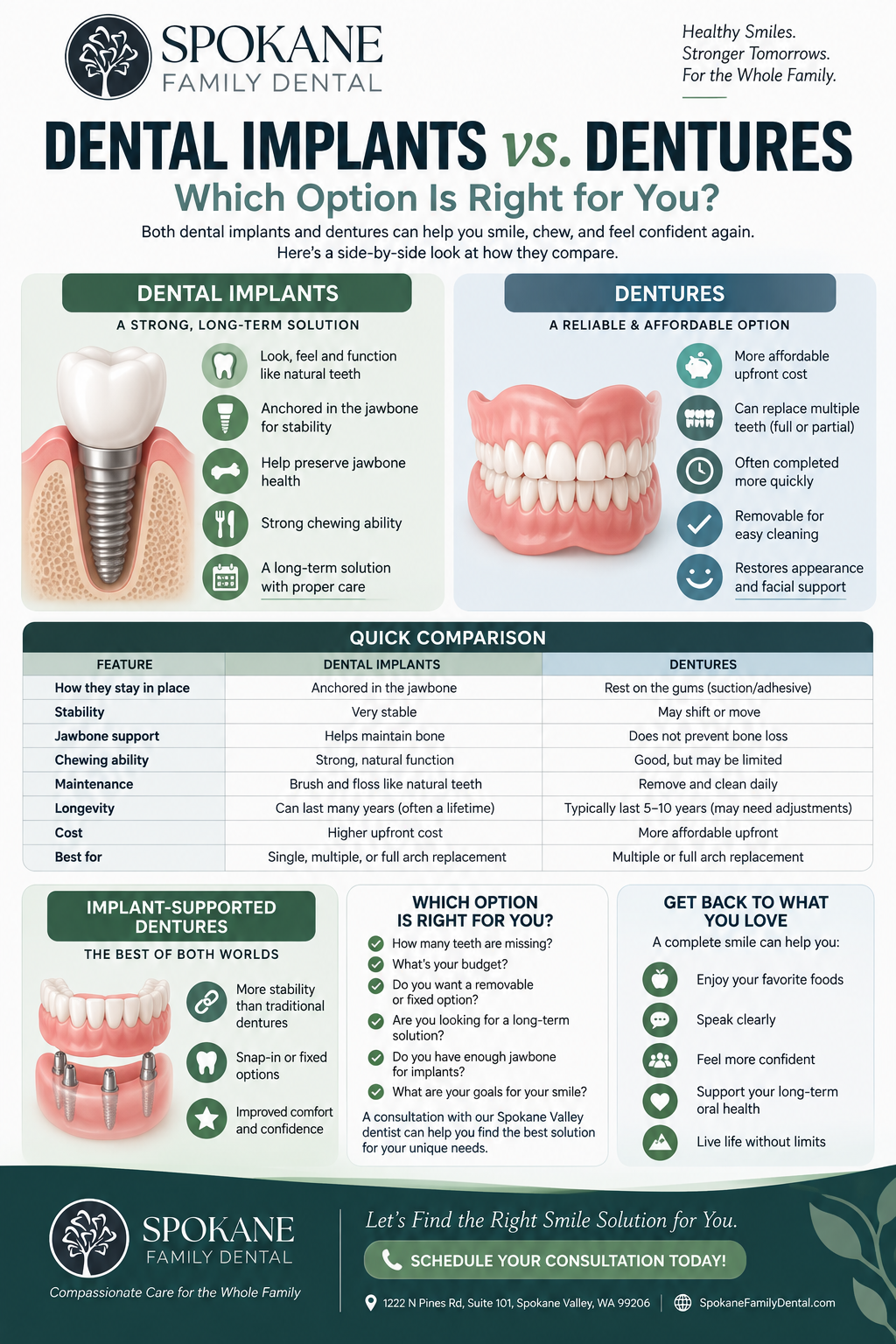
What Are Dental Implants?
Dental implants are designed to replace missing teeth by creating a stable foundation in the jawbone. A dental implant is a small post that is placed in the jaw and used to support a crown, bridge, or denture.
Once the implant has healed and bonded with the bone, it can provide strong support for a replacement tooth or larger restoration. This makes implants one of the most stable and natural-feeling tooth replacement options available.
Dental implants may be used to replace:
A single missing tooth
Multiple missing teeth
A full arch of missing teeth
Loose or uncomfortable dentures
Teeth that cannot be saved
For many patients, implants are appealing because they look, feel, and function more like natural teeth than removable options.
What Are Dentures?
Dentures are custom-made prosthetic teeth designed to replace missing teeth. Depending on your needs, dentures may replace a few missing teeth or a full set of upper or lower teeth.
There are several types of dentures, including complete dentures, partial dentures, and implant-supported dentures.
Complete dentures replace all teeth in the upper or lower jaw. Partial dentures fill gaps when some natural teeth remain. Implant-supported dentures attach to dental implants for added stability and comfort.
Modern dentures are designed to look more natural than many patients expect. They can restore chewing ability, improve facial support, and help patients feel more comfortable smiling again.
Dental Implants vs. Dentures: What Is the Main Difference?
The biggest difference between dental implants and traditional dentures is how they stay in place.
Traditional dentures rest on the gums and may rely on suction, clasps, or adhesive for support. Dental implants are anchored in the jawbone, creating a stronger foundation for replacement teeth.
This difference can affect comfort, chewing strength, stability, maintenance, and long-term oral health.
Dentures may be a more affordable and faster solution for some patients, especially when replacing many teeth at once. Dental implants often provide better stability and may help support jawbone health over time.
Neither option is automatically right for everyone. A dental exam and consultation can help determine which solution fits your situation best.
Benefits of Dental Implants
Dental implants offer several benefits for patients who are good candidates.
One major advantage is stability. Because implants are supported by the jawbone, they do not shift the same way removable dentures can. This can make eating, speaking, and smiling feel more natural.
Implants also help protect the jawbone. When a tooth is missing, the bone in that area no longer receives the same stimulation from chewing. Over time, the bone may begin to shrink. Dental implants help mimic the function of tooth roots, which can support bone health.
Additional benefits may include:
Natural-looking appearance
Strong chewing function
No need to reshape neighboring healthy teeth for a single-tooth replacement
Long-term support for crowns, bridges, or dentures
Improved confidence compared to loose removable options
For patients who currently struggle with loose dentures, implants can also be used to secure dentures more firmly.
Benefits of Dentures
Dentures remain a reliable and widely used tooth replacement option. They can be especially helpful for patients who are missing several teeth or need a more budget-conscious treatment plan.
One of the main benefits of dentures is that they can replace many teeth at once. Complete dentures can restore an entire arch of teeth, while partial dentures can fill multiple gaps.
Dentures may also be completed more quickly than implant treatment in some cases. Because dental implants require healing time, patients who want a removable option sooner may prefer dentures.
Benefits of dentures may include:
More affordable tooth replacement
Ability to replace multiple teeth
Improved appearance and facial support
Better speech and chewing compared to missing teeth
Removable design for cleaning
Options for full or partial tooth loss
For some patients, dentures are the right starting point. Others may later choose to upgrade to implant-supported dentures for additional stability.
What Are Implant-Supported Dentures?
Implant-supported dentures combine the benefits of dentures with the added support of dental implants. Instead of relying only on suction or adhesive, the denture attaches to implants placed in the jaw.
This can make the denture feel more secure and reduce unwanted movement while eating or speaking.
Implant-supported dentures may be removable or fixed, depending on the treatment plan. Some patients choose snap-in dentures that can be removed for cleaning, while others prefer fixed implant dentures that stay in place.
This option may be a strong fit for patients who want more stability than traditional dentures but need to replace many teeth.
Which Option Feels More Natural?
For many patients, dental implants feel more natural because they are anchored in the jaw and do not move like traditional dentures. Implant-supported restorations can provide stronger chewing function and greater confidence during daily activities.
Traditional dentures can still be comfortable and effective, especially when they fit well and are properly maintained. However, some patients experience movement, sore spots, or difficulty chewing certain foods.
If comfort and stability are your top priorities, dental implants or implant-supported dentures may be worth discussing with your dentist.
Which Option Is More Affordable?
Dentures are often more affordable upfront than dental implants. This makes them a practical option for patients who need to replace several teeth while keeping initial costs lower.
Dental implants usually cost more at the beginning because they involve surgical placement, healing time, and custom restorations. However, they may offer long-term value because of their stability, durability, and ability to support bone health.
The best choice depends on your budget, health, goals, and treatment timeline. During your consultation, your dentist can explain available options and help you compare the short-term and long-term considerations.
Are You a Candidate for Dental Implants?
Not every patient is immediately ready for dental implants. Good candidates usually need healthy enough gums, adequate jawbone support, and overall health that allows for proper healing.
If bone loss has already occurred, additional planning may be needed before implants can be placed. Patients with gum disease may also need periodontal treatment before beginning implant care.
Your dentist will evaluate your teeth, gums, jawbone, bite, and medical history before recommending treatment. Digital imaging may also be used to better understand your bone structure and treatment options.
Are You a Candidate for Dentures?
Dentures may be a good option for patients missing several teeth, patients who need full-arch replacement, or patients who want a removable tooth replacement solution.
Dentures can also be a practical choice for patients who are not ready for dental implants or who need a more affordable first step.
A denture consultation can help determine whether complete dentures, partial dentures, or implant-supported dentures would best fit your needs.
What Happens During a Tooth Replacement Consultation?
During a consultation at Spokane Family Dental, your dental team will review your oral health, discuss your goals, and explain your options.
Your visit may include a dental exam, digital X-rays, a review of your medical history, and a discussion about your budget and comfort preferences.
Your dentist may ask questions such as:
How many teeth are missing?
Are your current dentures loose or uncomfortable?
Do you want a removable or fixed option?
Are you interested in dental implants?
What foods are difficult for you to eat?
Are you concerned about appearance, comfort, or cost?
These answers help guide a treatment plan that is personalized to your needs.
Choosing the Right Tooth Replacement Option in Spokane Valley
The best tooth replacement option is the one that fits your health, lifestyle, and long-term goals.
Dental implants may be ideal if you want strong, stable, natural-feeling replacement teeth. Dentures may be a good option if you need to replace several teeth affordably and restore your smile more quickly. Implant-supported dentures may offer a middle ground for patients who want more stability than traditional dentures.
Spokane Family Dental provides personalized restorative care for patients throughout Spokane Valley and the surrounding Spokane area. Whether you are interested in dental implants, dentures, implant-supported dentures, or another solution for missing teeth, our team can help you understand your options and move forward with confidence.
Schedule a Tooth Replacement Consultation in Spokane Valley
Missing teeth can affect your comfort, confidence, and quality of life. You do not have to guess which treatment option is right for you.
If you are comparing dental implants and dentures, schedule a consultation with Spokane Family Dental. Our team will evaluate your oral health, answer your questions, and help you choose a tooth replacement plan designed around your smile.
Frequently Asked Dental Implants
-
Dental implants are often more stable and natural-feeling than traditional dentures, but they are not the right fit for every patient. Dentures may be more affordable upfront and can replace many teeth at once. The best choice depends on your oral health, budget, and goals.
-
Yes. Dental implants can be used to support dentures and help reduce slipping or movement. Implant-supported dentures may improve comfort, chewing ability, and confidence for patients who struggle with loose traditional dentures.
-
Dentures can last for years with proper care, but they may need adjustments, relines, or replacement over time as your mouth changes. Regular dental visits help ensure your dentures continue to fit properly.
-
Patients missing all upper or lower teeth may consider complete dentures, implant-supported dentures, or fixed implant restorations. The best option depends on jawbone health, budget, lifestyle preferences, and whether you want a removable or fixed solution.
